A club volunteer wants to copy the team list in a stapled match programme. The outer pages are easy to see, but the names nearest the centre disappear into the fold. Pushing the booklet flat seems a small adjustment. For an original with weakened paper, that adjustment may become the damage the digital copy was meant to prevent.
Start with the item, before choosing the machine. The US National Archives' guidance on digitising papers and photographs recommends a copy stand and supports for books, allowing the binding to open without force. A programme needs the same initial question: can the required page be seen while its joined edge remains comfortable?
The fold sets the limit
Look at how the programme is held together and where it resists opening. A sound-looking cover does not tell you whether the inner fold is strong. Loose pages, tearing beside a staple or a brittle edge are reasons to stop and ask the person responsible for the collection how the item should be handled. This is a copying decision, not an invitation to remove staples, tape a tear or separate the pages.
In the example, the missing names are a limitation to record. They are not permission to bend the programme backwards. A volunteer can note which page and part of the text cannot safely be captured, so the collection can decide whether specialist help is worthwhile. An incomplete but honestly described copy is preferable to silently sacrificing the original for a tidy image.
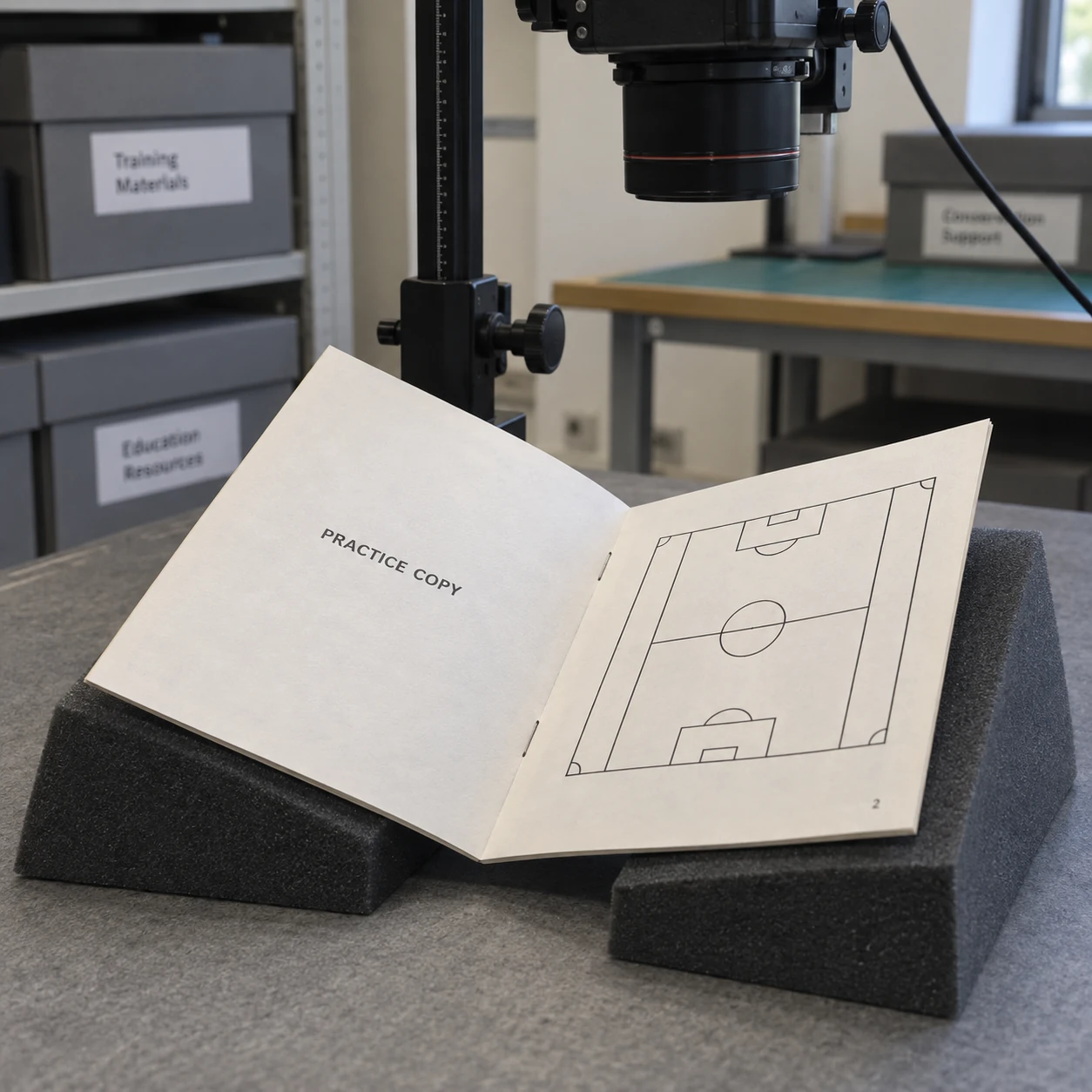 Generated training illustration: a modern practice booklet shows a supported opening. It is not a photograph of a historical collection item.
Support the opening you have
The University of Leeds' handling guidance for historic material calls for clean hands and book supports, and warns against leaning on items or bending them back to reveal hidden text. Work on a clear surface and use the supports provided or approved by the collection. Ask for help when the arrangement feels unstable.
The illustrated practice booklet rests on two foam wedges. Its covers and pages are supported at an angle, with no hand pressing the centre down. The camera is supported separately; neither its weight nor the photographer's arm rests on the paper. A training copy lets volunteers understand that arrangement before working with a valued original. It does not establish a universally safe opening angle.
For a genuinely flat, loose sheet, a flatbed may be appropriate if the whole item fits. NARA warns that an overhanging original can be crushed by the lid and that automatic feeders can tear fragile material. A stapled programme should not be treated as a stack of office documents merely because a feeder would be quicker.
Check one image before copying the rest
Make a trial image within the safe opening. Check whether the page edges, small print and any handwritten annotation are legible. If the centre remains obscured, improve the camera position or lighting without forcing the paper. Stop if getting a clearer view would require changing the item's condition.
Keep the page order and explain any missing view. Link the image files to the programme's existing catalogue reference; the site's guide to collection records covers that connection in more detail. Retain the original after copying. The useful result is a readable, traceable view of the programme, with its physical evidence still available for the next researcher.
This page was added on 9 September 2026.
