A box of programmes, a player’s boots or a club photograph can tell an important sporting story. An online record helps people discover that story, but only if it remains connected to the object and to the information your museum, club or community group already knows.
You do not need an expensive collections system to begin. Before you upload a new collection or object, record these six details in a consistent form. If something is not known, say so rather than guessing.
1. Give it a stable reference number
Assign one unique reference to the object or group. Use the same reference on the record, the storage location and the digital filename. Do not build changeable information such as a shelf number, player name or subject category into the identifier.
The Collections Trust suggested cataloguing procedure places a unique object number at the centre of the record and links it to core inventory information. That link matters more than the software used to hold it.
Example: CLUB-2026-014 can identify one accession, while separate item references can distinguish the boots, photograph and programme inside it.
2. Use a plain object name and a brief visual description
Start with what the object is, then add the details that would help someone distinguish it from a similar item. “Football boot” is clearer than “historic treasure”. A useful short description might note material, colour, shape, manufacturer’s mark, visible wear and whether the pair is complete.
Describe what can be seen before interpreting what it means. If an attribution is uncertain, keep the observation and the claim separate: “Brown leather boot with six pairs of eyelets; believed to have been worn during the 1954 season.”
For a group, record the number and types of items. This helps another volunteer notice if something is missing later.
3. Record people, team, place and date — including uncertainty
Names and dates make sporting collections searchable, but inherited labels are not always correct. Record the person or organisation associated with the item, the type of association, the place and the date or date range. Keep the source of that information too.
Use a consistent form for names and dates. If the donor says a photograph shows a particular cup final, note that source. If the evidence is only a comparison with another image, write “possibly” or “circa” and leave a route for later correction.
Large club archives may need a collection-level record as well as item records. The National Archives explains in its guide to cataloguing archive collections that archive catalogues use levels, from a broad collection or fonds through series, files and sometimes individual items. A simple hierarchy preserves the relationship between a committee minute book, a season file and one match document.
4. Say where it came from and who owns or controls it
Record who donated, deposited or lent the material, when it arrived and whether ownership transferred. Keep any agreement, correspondence or restrictions linked to the reference number. Do not publish private contact details in the public record.
Ownership of the physical object is not automatically the same as copyright in a photograph, film or programme design. Add a rights field with a clear status such as “rights held”, “permission recorded”, “copyright unknown” or “not cleared for online publication”. If the position is uncertain, publish only what you are authorised to share.
5. Record current location and condition
The public description may say that an item is held by a club museum, but the working record should identify its exact box, shelf or display location. Update that location whenever the item moves.
Add a short condition note before handling or photography. For leather boots, that might include loose stitching, dry or cracked leather, corrosion on eyelets, detached studs or an old repair. The note is not a conservation treatment; it is a baseline that helps you recognise change and handle the item appropriately.
Keep precise store locations out of the public page if they create a security risk. The public and internal versions can share the same reference without exposing sensitive detail.
6. Link photographs and digital files back to the record
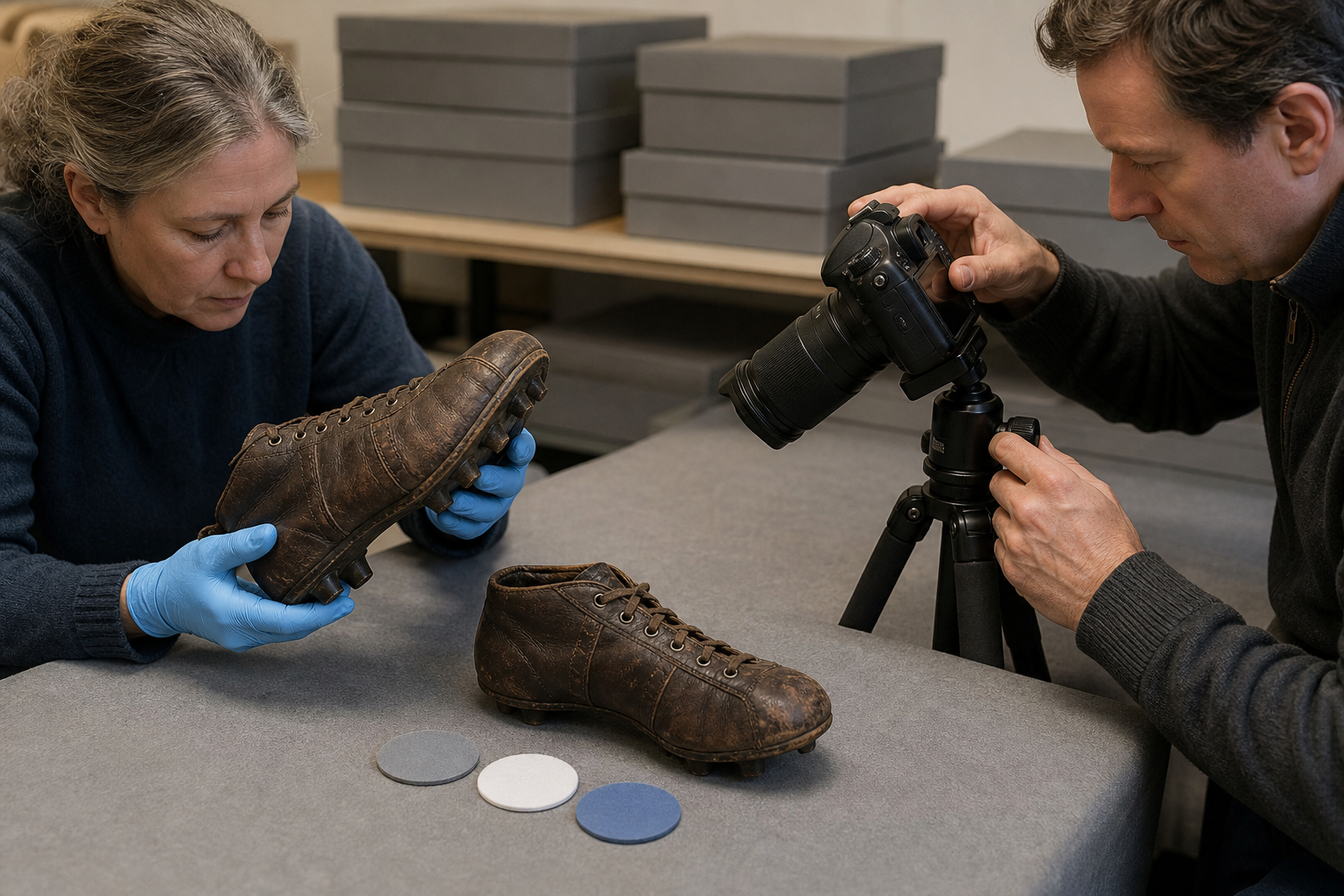 Inspect and identify the object before making its public image.
Photograph after you have numbered and described the object. Include an overall view and any detail that supports identification or condition. Check that a pair is photographed as a pair and that the image does not introduce a wrong label, colour cast or misleading crop.
Name the master file with the stable reference, then record the filename in the catalogue. Keep the original master separate from resized web copies. The National Lottery Heritage Fund's guide to doing digitisation on a budget recommends planning rights, metadata, storage, publication and deposit as connected stages rather than treating the scan or photograph as the end of the job.
Make at least one managed backup and record who is responsible for it. A picture on a social account is not a preservation copy, and a file without a reference can soon become an unidentified image.
A final check before upload
- Can another person match this record to the object or group?
- Is the description factual, with uncertainty clearly marked?
- Are people, team, place and date in separate searchable fields?
- Are provenance, ownership and publication rights recorded?
- Can authorised staff find the object without exposing its secure location online?
- Do the photographs and master files point back to the same stable reference?
A short, consistent record is more useful than a long story with no object number or source. Start with the six details, link fuller research when it becomes available, and keep an amendment note whenever information changes. That makes a sports collection easier to discover today and safer to hand to the next volunteer tomorrow.
This page was added on 29 August 2026.
