A scuffed football, a race medal or a faded club scarf can do more than illustrate a sporting memory. Put one familiar item between a former player and a museum volunteer, and it can bring back the sound of a changing room, the route to a ground, the people who were present and the small routines that never reached a match report.
That conversation becomes oral history only when it is deliberately recorded, documented and kept for future use. The National Lottery Heritage Fund's oral-history guidance stresses that memories, feelings and attitudes need professional recording and archiving if they are to remain accessible. The object can focus a manageable first session without reducing the speaker's experience to a list of dates.
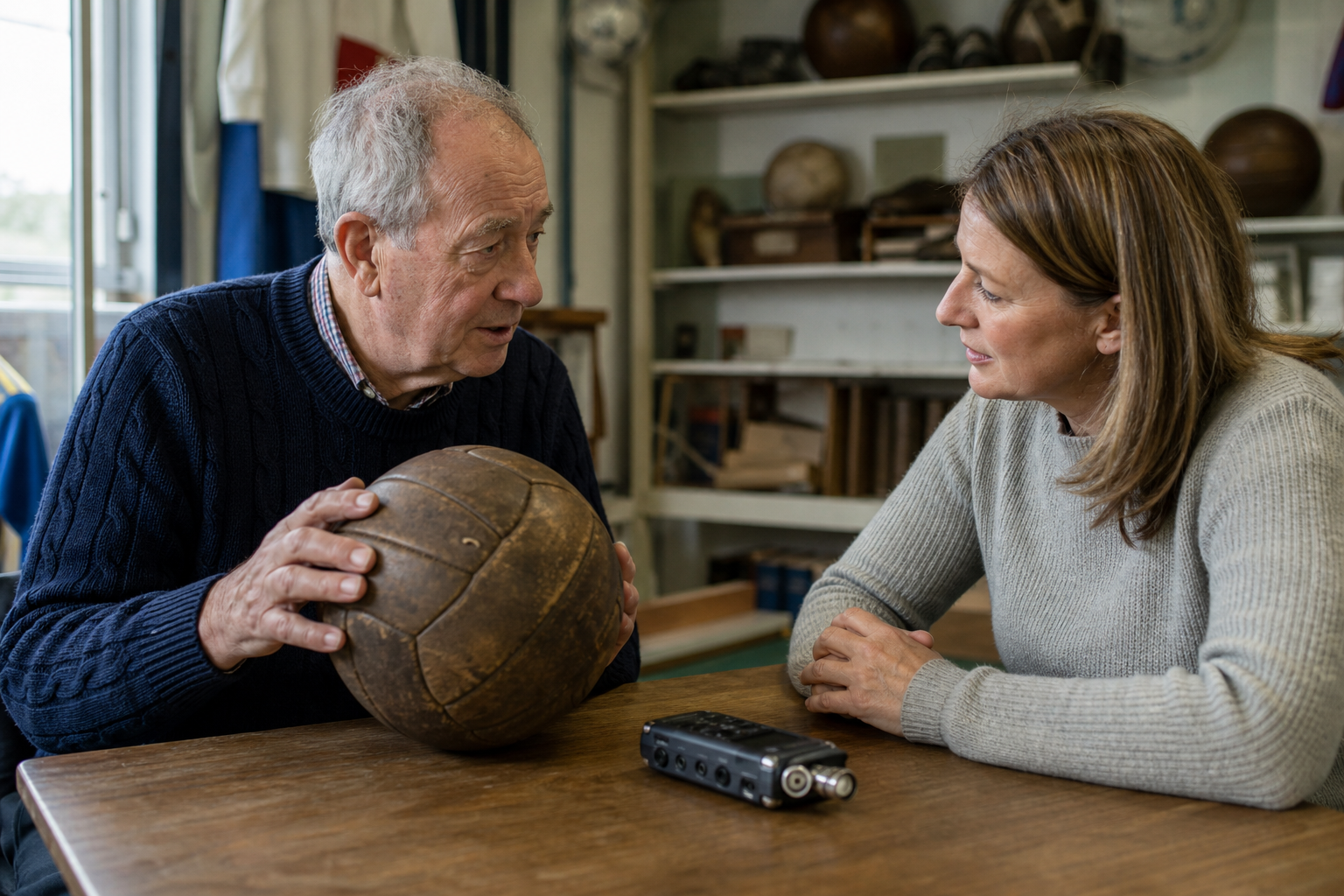 One familiar object gives the speaker a concrete place to begin, while the interviewer leaves room for the memory to unfold.
The item gives the first question
Begin with observation rather than a claim. Ask the speaker what they notice first, when they remember handling the object and where it would normally have been kept. A worn leather football might lead to the weight of a wet ball, the smell of a store room or the person who carried the kit. Those details are valuable because they connect material evidence with lived practice.
Avoid building the expected answer into the question. “Was this used in the cup final?” invites agreement. “What do you remember about this ball?” gives the speaker room to correct the premise, introduce another event or say that they do not know. Keep the catalogue description nearby for the interviewer, but do not use it as a script the speaker is expected to confirm.
The item should also be safe to handle. If it is fragile, heavy or normally kept in controlled storage, use a good photograph or view it in its case. The interview is not worth causing new damage, and the speaker should never feel that touching the object is a test of memory.
Follow one sporting moment, not a questionnaire
Once the object has opened the conversation, follow a single moment through time. Ask what happened before the match or meeting, who was nearby, what could be heard, and what changed afterwards. This sequence often produces a clearer account than jumping between names, seasons and results.
Listen for words that carry a particular local meaning. A nickname for a stand, a training drill or a volunteer role may need a follow-up question, but it should not be translated into modern terminology while the person is speaking. The Heritage Fund's advice on learning to listen emphasises attention to pauses, repetition and what is not immediately said. A short silence can be more useful than the next prepared question.
Two people may remember the same day differently. Do not make the session into a contest whose job is to select one winner. Record each account with its speaker and date, then compare it later with programmes, photographs, minutes or other testimony. The disagreement is part of the history and should remain visible as such.
Agree what may be recorded and shared
Before switching on the recorder, explain the theme, who will keep the file, how it may be used and whether an extract could appear online or in an exhibition. Give the speaker time to ask questions and to set limits. A friendly conversation beside a collection item does not by itself grant permission to preserve or publish a person's voice.
The Oral History Society's guidance on informed consent says participants need clear information about storage, preservation, long-term use and any promised confidentiality. Use the recording agreement and data-protection process approved by the museum or archive. If those arrangements are not ready, postpone the recorded interview rather than improvise them.
Say clearly when the recorder starts and stops. Conversation after the formal ending should not quietly become part of the archive. If a sensitive name or event arises, note the point for a later access review instead of asking the speaker to make a rushed decision in the room.
Keep the voice and the object record in dialogue
An oral account can explain how an object was used, valued or remembered, but it should not silently replace the object's existing evidence. Cross-reference the interview to the object's stable number, and add the speaker, interviewer, date, place, file reference and a short content summary to the recording record.
Where the testimony makes a new identification, write it as an attributed statement: “Remembered by A. Patel in an interview recorded on 30 August 2026,” not simply “worn in the 1962 final.” A programme or photograph may later support, refine or contradict that memory. Keeping the attribution protects both the catalogue and the speaker from false certainty.
Time markers make the recording usable. Note where the speaker discusses the object, a named person, a venue or a change in club practice. A future volunteer can then find the relevant passage without treating a full interview as an unsearchable sound file.
Finish by making the recording findable
At the end, confirm what will happen next and whether the speaker wants to add anything that the object did not prompt. Then copy the recording into managed storage, keep a second protected copy, and record the filename against the interview reference. Personal contact details belong in the organisation's controlled system, not in a public summary.
The British Library's National Life Stories programme shows why an interview needs both careful fieldwork and a durable archival home: recorded voices become useful when they can be preserved, discovered and consulted within clear access terms. A small club project may use simpler tools, but it still needs a named custodian and a plan for what happens when the first volunteer steps away.
The best result is not the longest recording. It is a respectful account with an agreed future, a clear connection to the sporting object and enough documentation for someone else to understand what they are hearing. One item can open a rich memory; good archive work makes sure the voice does not become detached from it again.
This page was added on 30 August 2026.
